
Relative effects, absolute outcomes, and study limitations must be interpreted together before evidence changes clinical practice.
Papers Worth Knowing — Preventive medicine and screening
New studies. Different outcomes. Better clinical questions.
PREVENTIVE MEDICINE
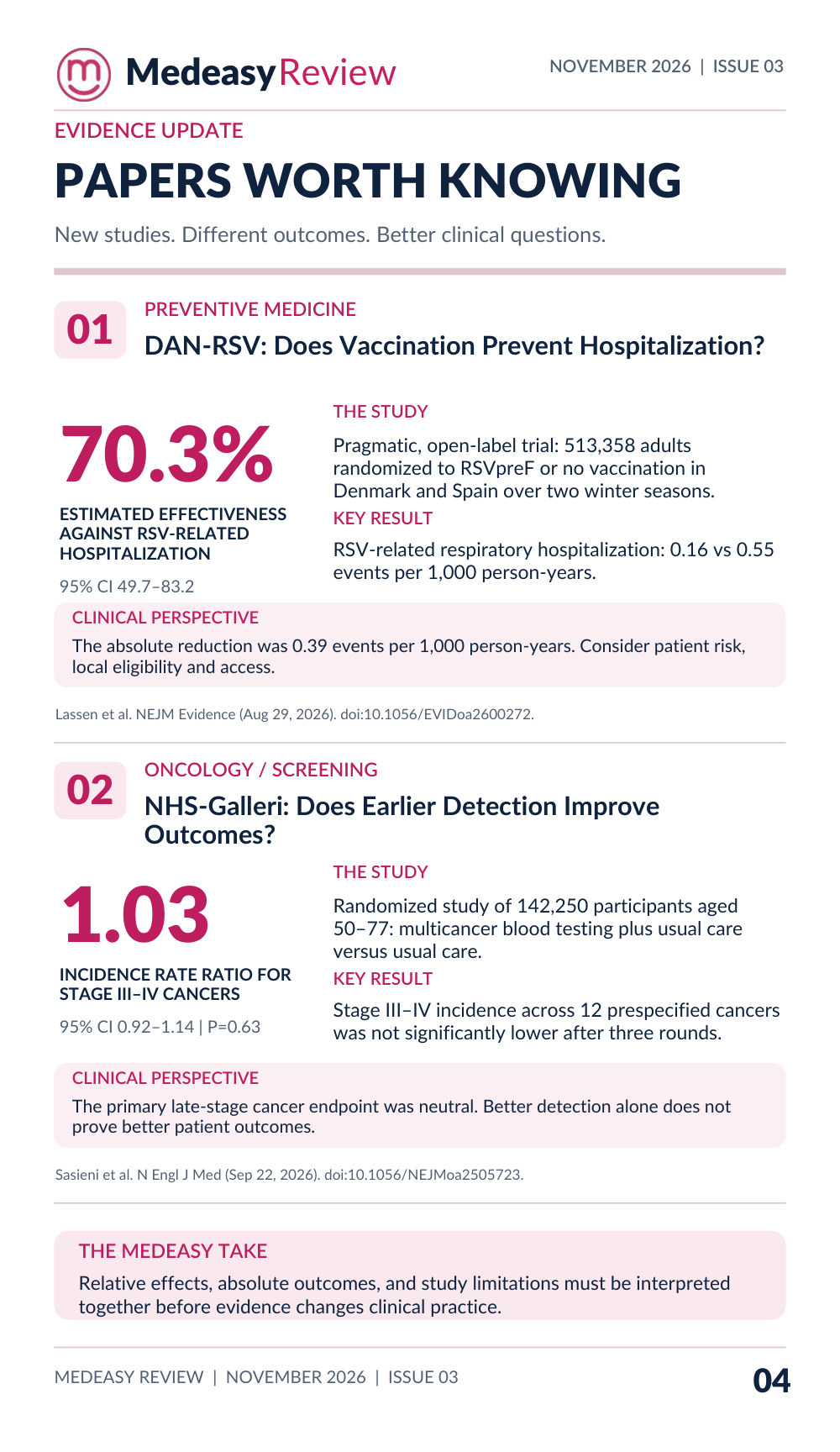
DAN-RSV: Does Vaccination Prevent Hospitalization?
70.3%
ESTIMATED EFFECTIVENESS
AGAINST RSV-RELATED
HOSPITALIZATION
95% CI 49.7–83.2
THE STUDY
Pragmatic, open-label trial: 513,358 adults randomized to RSVpreF or no vaccination in Denmark and Spain over two winter seasons.
KEY RESULT
RSV-related respiratory hospitalization: 0.16 vs 0.55 events per 1,000 person-years.
CLINICAL PERSPECTIVE
The absolute reduction was 0.39 events per 1,000 person-years. Consider patient risk, local eligibility and access.
ONCOLOGY / SCREENING
NHS-Galleri: Does Earlier Detection Improve Outcomes? 1.03
INCIDENCE RATE RATIO FOR
STAGE III–IV CANCERS
95% CI 0.92–1.14 | P=0.63
THE STUDY
Randomized study of 142,250 participants aged 50–77: multicancer blood testing plus usual care versus usual care.
KEY RESULT
Stage III–IV incidence across 12 prespecified cancers was not significantly lower after three rounds.
CLINICAL PERSPECTIVE
The primary late-stage cancer endpoint was neutral. Better detection alone does not prove better patient outcomes.
THE MEDEASY TAKE
Relative effects, absolute outcomes, and study limitations must be interpreted together before evidence changes clinical practice.
Papers Worth Knowing — New therapies
Different specialties. Important advances. Questions that remain.
PEDIATRIC HEMATOLOGY
Blinatumomab: Replacing Selected Chemotherapy Cycles 83.0% vs 70.3%
ESTIMATED 4-YEAR
EVENT-FREE SURVIVAL
HR 0.51 (95% CI 0.35–0.73)
THE STUDY
709 children with newly diagnosed high-risk B-cell ALL were randomized after consolidation: two cycles of blinatumomab replaced two chemotherapy cycles.
KEY RESULT
Estimated 4-year EFS: 83.0% vs 70.3% (HR 0.51). Interim analysis; median follow-up 2.9 years.
CLINICAL PERSPECTIVE
Only two selected chemotherapy cycles were replaced. EFS improved, but neurotoxic events were more frequent (12.0% vs 3.2%).
NEUROLOGY / SLEEP MEDICINE
Oveporexton: An Orexin-Based Approach to Narcolepsy Type 1 +14.3 to +19.8 min
MEAN CHANGE IN MWT
SLEEP LATENCY
Active-treatment groups at week 12
THE STUDY
Two placebo-controlled phase 3 trials enrolled 168 and 105 people with narcolepsy type 1.
KEY RESULT
MWT sleep-latency change: +14.3 to +19.8 minutes with oveporexton vs −0.4 to −0.8 with placebo (12 weeks).
CLINICAL PERSPECTIVE
Wakefulness and cataplexy improved. Urinary frequency and transient insomnia were common; long-term safety remains uncertain.
THE MEDEASY TAKE
New therapies deserve attention, but outcomes and safety determine clinical value.
Read the original magazine · pages 4–5
References
- Lassen et al. NEJM Evidence (Aug 29, 2026). doi:10.1056/EVIDoa2600272.
- Sasieni et al. N Engl J Med (Sep 22, 2026). doi:10.1056/NEJMoa2505723.
- Schrappe et al. N Engl J Med (2026);395:1075–89. doi:10.1056/NEJMoa2604166.
- Dauvilliers et al. N Engl J Med (2026);395:1166–79. doi:10.1056/NEJMoa2601598.
Editorial content from Medeasy Review Issue 03. Verify recommendations against current guidelines, local approvals, product information, and the individual patient's circumstances.