Protect the patient, not just the HbA1c. Recognize risk early, use proven therapy when appropriate, and keep care sustainable.
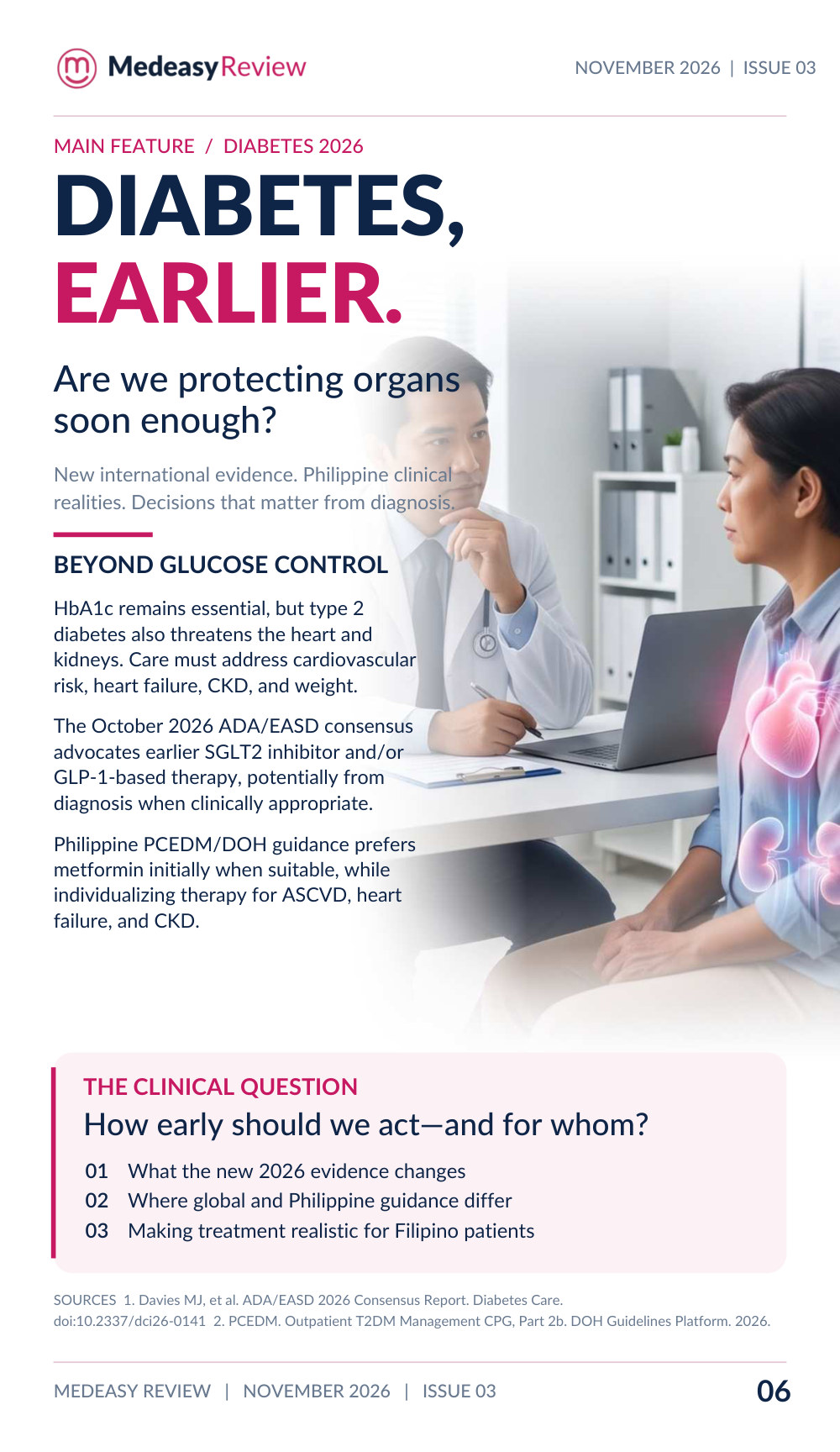
Diabetes, Earlier.
Are we protecting organs soon enough?
New international evidence. Philippine clinical realities. Decisions that matter from diagnosis.
BEYOND GLUCOSE CONTROL
HbA1c remains essential, but type 2 diabetes also threatens the heart and kidneys. Care must address cardiovascular risk, heart failure, CKD, and weight.
The October 2026 ADA/EASD consensus advocates earlier SGLT2 inhibitor and/or GLP-1-based therapy, potentially from diagnosis when clinically appropriate.
Philippine PCEDM/DOH guidance prefers metformin initially when suitable, while individualizing therapy for ASCVD, heart failure, and CKD.
THE CLINICAL QUESTION
How early should we act—and for whom?
What the new 2026 evidence changes Where global and Philippine guidance differ Making treatment realistic for Filipino patients
What Really Changes in 2026?
Earlier intervention. Broader goals. More individualized decisions.
AN EVOLUTION, NOT A REVERSAL
The 2022 ADA/EASD consensus already supported SGLT2 inhibitors and GLP-1 receptor agonists with proven cardiovascular or kidney benefits in selected patients, independent of HbA1c or metformin use. The 2026 update emphasizes earlier, risk-led treatment and holistic care for people living with type 2 diabetes.
THREE IMPORTANT DEVELOPMENTS
ORGAN PROTECTION MOVES EARLIER
Consider proven organ-protective therapies early in patients with ASCVD, heart failure, CKD, or other relevant risk—even at diagnosis when indicated.
Clinical implication: Assess organ risk early, not only HbA1c.
COMBINATION THERAPY: SELECTIVE USE
An SGLT2 inhibitor plus GLP-1-based therapy may be considered in selected patients with CVD, CKD, or heart failure. Evidence is agent- and outcome-specific.
Clinical implication: Combination treatment is not universal.
BROADER GOALS BEYOND HbA1c
Weight, heart and kidney health, liver disease, physical activity, sleep, psychological well-being, and personal priorities matter alongside glucose control.
Clinical implication: Set goals beyond one laboratory number.
WHAT HAS NOT CHANGED?
HbA1c targets and lifestyle care remain important. Metformin continues to be useful, accessible, and affordable when appropriate. Drug selection still requires shared decisions about benefits, tolerability, safety, and cost.
THE MEDEASY TAKE
The 2026 message is about timing and patient selection—not using every newer drug for every person with diabetes.
Same Goal. Different Starting Points.
ADA/EASD 2026 versus Philippine PCEDM guidance
Both address glucose control and organ protection. The difference lies mainly in treatment emphasis and sequencing, not conflicting clinical goals.
| Clinical question | ADA/EASD 2026 | Philippine PCEDM |
|---|---|---|
| WHERE DOES TREATMENT BEGIN? | Early SGLT2 inhibitor and/or GLP-1-based therapy may be appropriate, potentially at diagnosis, when clinical risks and evidence support it. Metformin need not precede indicated organ protection. | Metformin is preferred initially when tolerated. Initial therapy can be individualized for contraindications or a profile that includes CHF, ASCVD or CKD. |
| WHEN DOES ORGAN PROTECTION TAKE PRIORITY? | For relevant cardiovascular or kidney disease, prioritize therapies with demonstrated outcomes. Earlier SGLT2/GLP-1 combination therapy may be considered in selected higher-risk patients. | Recommends SGLT2 inhibitors in T2DM with CKD at eGFR ≥20 mL/min/1.73 m², and supports SGLT2 therapy in heart failure and GLP-1 RAs in selected profiles. |
| HOW DO COST AND ACCESS SHAPE DECISIONS? | Includes affordability, access to care, patient preferences and social determinants when individualizing evidence-based treatment. | Includes resource-limited treatment options and patient-centered selection. Access constraints do not negate indications for beneficial therapies. |
THE PHILIPPINE PRACTICE CHECK
Screen for ASCVD, heart failure and CKD; check eGFR and urine albumin. Check contraindications, affordability, likely adherence and follow-up. Choose drugs with outcome evidence that matches the patient profile.
THE MEDEASY TAKE
These are not competing treatment philosophies. Start with organ risk and clinical indications, then make evidence-based care feasible for the Filipino patient.
Three Patients. Three Different Priorities.
HbA1c alone cannot determine treatment priorities. These fictional Philippine outpatient cases show how organ disease, clinical risk, and access influence care.
Illustrative cases only; not individualized prescribing instructions.
| Patient profile | Clinical priority | Evidence-informed approach | Philippine reality |
|---|---|---|---|
| Newly diagnosed · limited budget. Age 47 | HbA1c 7.4% | eGFR 93 No known ASCVD, heart failure or CKD. | Set an individualized glucose goal and assess overall cardio-kidney risk. | Metformin is reasonable initially if tolerated and suitable, with lifestyle support and follow-up. | PH REALITY · Choose an affordable regimen the patient can maintain. |
| CKD with near-target HbA1c. Age 62 | HbA1c 6.9% | eGFR 42 | UACR 220 mg/g Established CKD; currently taking metformin. | Slow kidney decline and reduce cardiovascular risk, not merely HbA1c. | Consider an SGLT2 inhibitor with proven kidney benefit; review renal status and precautions. | PH REALITY · Check access, tolerability and capacity for follow-up. |
| Previous MI and obesity. Age 57 | HbA1c 7.8% | BMI 31 kg/m² Prior myocardial infarction and ongoing ASCVD risk. | Reduce recurrent CV events while addressing glycemia and weight. | Consider GLP-1-based therapy with proven CV benefit alongside secondary prevention. | PH REALITY · Match evidence, tolerability and affordability to lasting treatment. |
The Medeasy Take
Treatment priorities depend on more than HbA1c.
From Evidence to Everyday Practice
Five decisions that make diabetes care better.
A practical framework for choosing, sustaining, and reassessing treatment.
IDENTIFY THE DOMINANT RISK
Assess ASCVD, heart failure, CKD, weight, eGFR, and UACR alongside HbA1c to identify organ risk.
CLINICAL PEARL HbA1c alone does not define cardio-kidney risk.
CHOOSE TREATMENT FOR THE OUTCOME
Prioritize agents with demonstrated cardiovascular or kidney benefits when indicated. Metformin remains valuable when appropriate and accessible.
PRESCRIBE WITH SAFETY IN MIND
Review kidney function, contraindications, and interactions. Discuss SGLT2-related volume depletion and ketoacidosis, plus GLP-1 gastrointestinal effects.
MAKE THE PLAN SUSTAINABLE
Discuss cost, availability, monitoring, patient preferences, and realistic follow-up. Choose a regimen the patient can maintain.
CLINICAL PEARL Benefits depend on access, adherence, and treatment persistence.
REASSESS AND ADJUST
Monitor glycemia, tolerability, adherence, cardiovascular risk factors, and kidney parameters as appropriate. Adjust therapy as priorities change.
WHAT REMAINS UNCERTAIN?
Optimal sequencing and additive long-term benefits in some subgroups; equitable access and persistence in practice.
THE MEDEASY TAKE
Protect the patient, not just the HbA1c. Recognize risk early, use proven therapy when appropriate, and keep care sustainable.
Read the original magazine · pages 6–10
References
- Davies MJ, et al. ADA/EASD 2026 Consensus Report. Diabetes Care. 2026. doi:10.2337/dci26-0141.
- Davies MJ, et al. ADA/EASD Consensus Report. Diabetes Care. 2022. doi:10.2337/dci22-0034.
- PCEDM. Outpatient T2DM Management CPG, Part 2b. DOH Guidelines Platform. 2026.
Editorial content from Medeasy Review Issue 03. Verify recommendations against current guidelines, local approvals, product information, and the individual patient's circumstances.