FIB-4 is a triage tool, not a final diagnosis. Normal ALT and low scores do not eliminate clinical judgment.
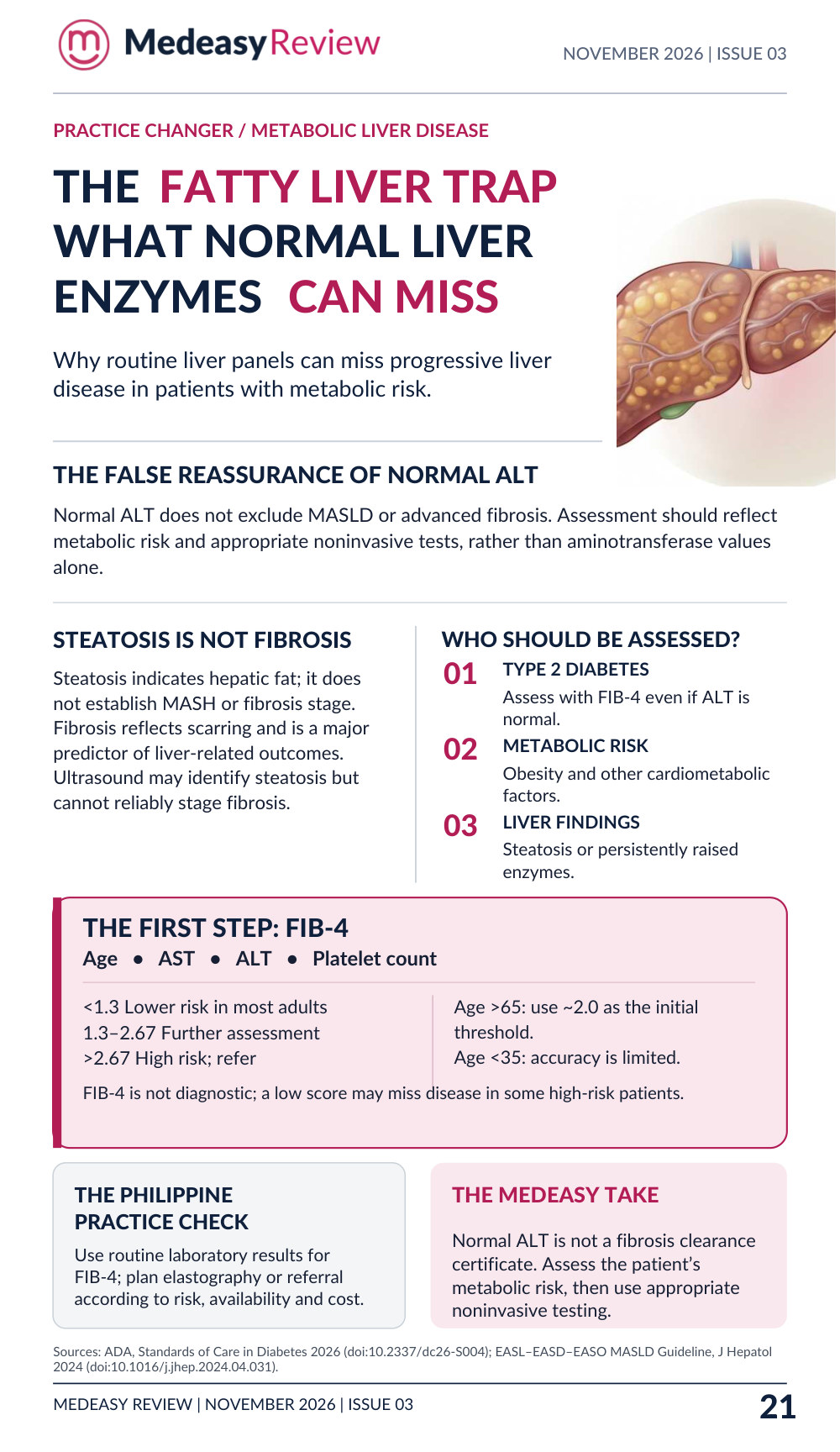
The Fatty Liver Trap: What Normal Liver Enzymes Can Miss
Why routine liver panels can miss progressive liver disease in patients with metabolic risk.
THE FALSE REASSURANCE OF NORMAL ALT
Normal ALT does not exclude MASLD or advanced fibrosis. Assessment should reflect metabolic risk and appropriate noninvasive tests, rather than aminotransferase values alone.
STEATOSIS IS NOT FIBROSIS
Steatosis indicates hepatic fat; it does not establish MASH or fibrosis stage. Fibrosis reflects scarring and is a major predictor of liver-related outcomes. Ultrasound may identify steatosis but cannot reliably stage fibrosis.
Who should be assessed?
Type 2 diabetes: assess with FIB-4 even if ALT is normal. Metabolic risk: obesity and other cardiometabolic factors. Liver findings: steatosis or persistently raised enzymes.
The first step: FIB-4
Age · AST · ALT · Platelet count
| FIB-4 | Interpretation |
|---|---|
| <1.3 | Lower risk in most adults |
| 1.3–2.67 | Further assessment |
| >2.67 | High risk; refer |
Age >65: use ~2.0 as the initial threshold. Age <35: accuracy is limited.
FIB-4 is not diagnostic; a low score may miss disease in some high-risk patients.
THE PHILIPPINE
PRACTICE CHECK
Use routine laboratory results for FIB-4; plan elastography or referral according to risk, availability and cost.
THE MEDEASY TAKE
Normal ALT is not a fibrosis clearance certificate. Assess the patient’s metabolic risk, then use appropriate noninvasive testing.
From Risk Score to Referral
What to do after FIB-4—and when liver stiffness changes the decision.
Interpret FIB-4 in context
A first-line assessment of advanced fibrosis risk
| Score | Risk | Next step |
|---|---|---|
| <1.3 | Lower risk | Continue metabolic care and reassess. In type 2 diabetes, repeat FIB-4 about every 1–2 years. |
| 1.3–2.67 | Further testing | Obtain VCTE; consider ELF if VCTE is unavailable. Interpret with patient risk and age. |
| >2.67 | Higher risk | Consider direct hepatology referral to assess fibrosis risk and other liver conditions. |
Age ≥65: use 2.0 as the initial FIB-4 threshold. Age <35: FIB-4 performs poorly; clinical risk can justify other assessment.
When elastography helps
Vibration-controlled transient elastography (VCTE) adds liver stiffness measurement; it does not establish a histological stage.
| Liver stiffness | Interpretation |
|---|---|
| <8 kPa | Lower probability of advanced fibrosis. Continue risk-factor management and periodic follow-up. |
| ≥8 kPa | Greater risk of advanced fibrosis. Arrange further evaluation and specialist referral; not diagnostic of F2–F4. |
Know when scores mislead
Acute illness can distort FIB-4; inflammation, congestion and cholestasis may increase liver stiffness. Persistent enzyme elevation, discordant tests or clinical red flags warrant further evaluation.
THE PHILIPPINE PRACTICE CHECK
Start with available labs. Arrange VCTE/ELF when indicated; prioritize referral if risk is high or tests disagree.
THE MEDEASY TAKE
FIB-4 is a triage tool, not a final diagnosis. Normal ALT and low scores do not eliminate clinical judgment.
Read the original magazine · pages 21–22
References
- ADA, Standards of Care in Diabetes 2026 (doi:10.2337/dc26-S004); EASL–EASD–EASO MASLD Guideline, J Hepatol 2024 (doi:10.1016/j.jhep.2024.04.031).
- ADA Standards of Care 2026, Sec. 4; EASL–EASD–EASO MASLD CPG 2024.
Editorial content from Medeasy Review Issue 03. Verify recommendations against current guidelines, local approvals, product information, and the individual patient's circumstances.