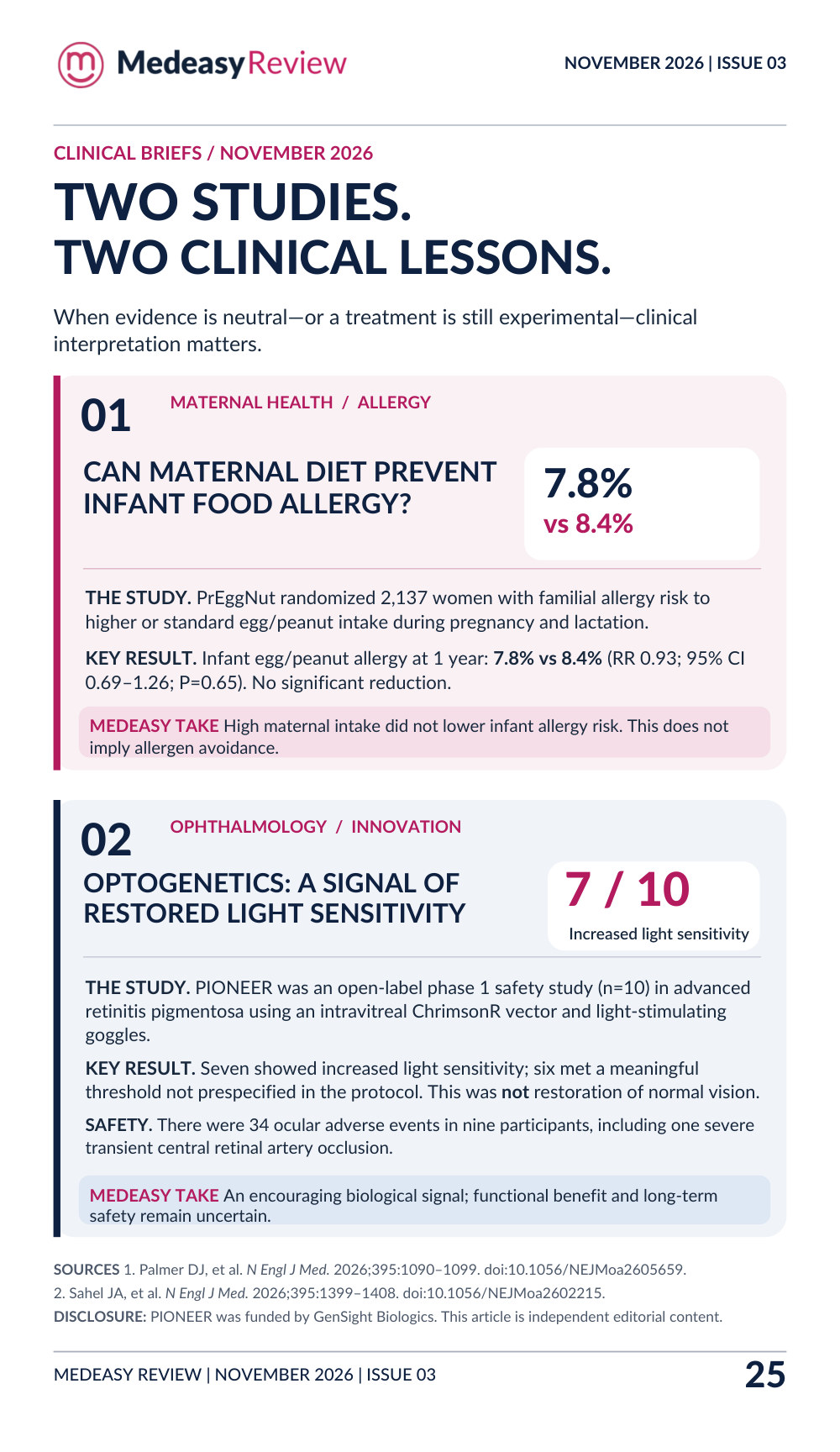
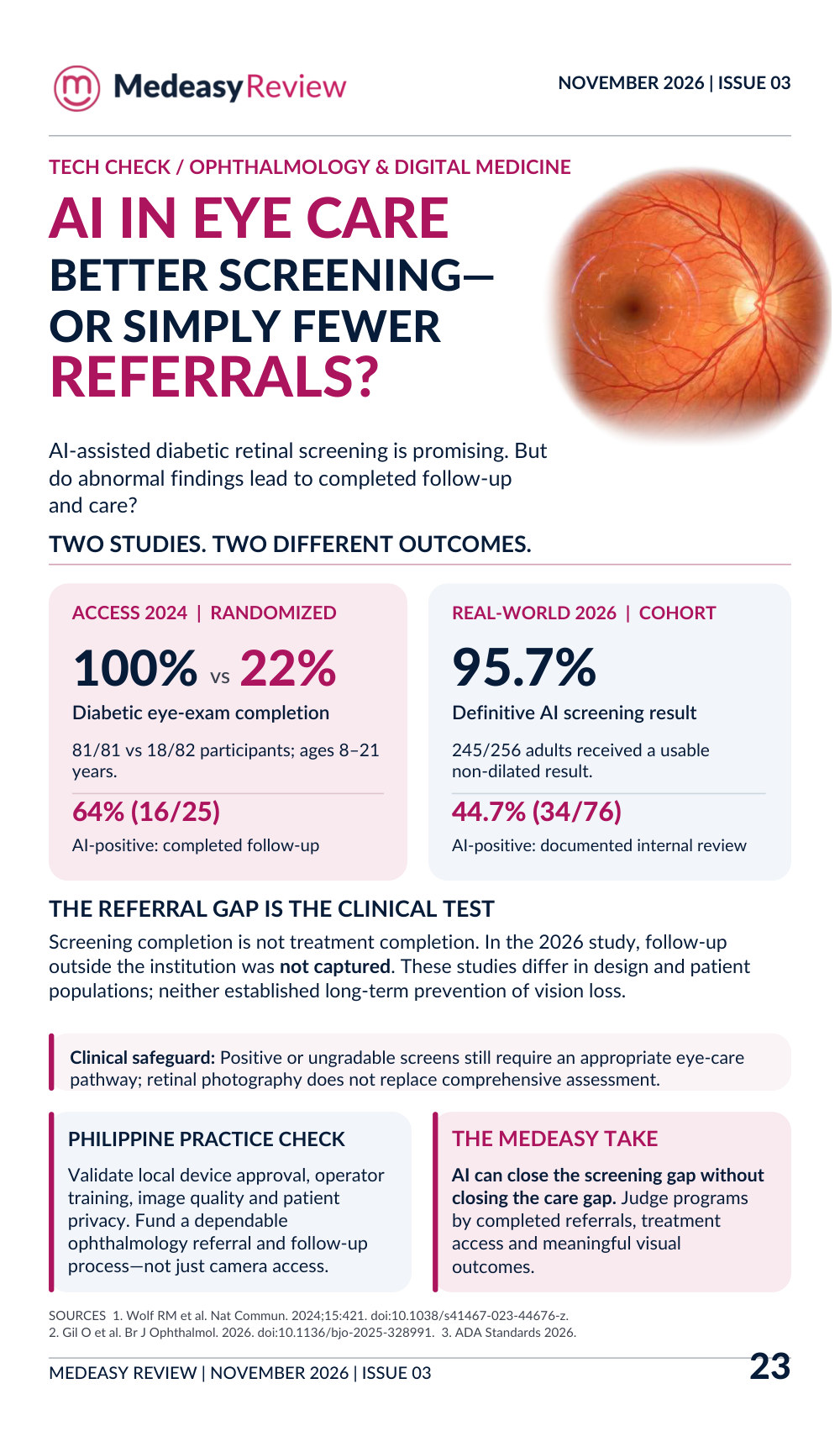
AI can close the screening gap without closing the care gap. Judge programs by completed referrals, treatment access and meaningful visual outcomes.
AI in Eye Care: Better Screening—or Simply Fewer Referrals?
AI-assisted diabetic retinal screening is promising. But do abnormal findings lead to completed follow-up and care?
| Study | Screening outcome | AI-positive follow-up |
|---|---|---|
| ACCESS 2024 · Randomized | 100% vs 22% diabetic eye-exam completion; 81/81 vs 18/82 participants; ages 8–21 years. | 64% (16/25) completed follow-up. |
| Real-world 2026 · Cohort | 95.7% (245/256 adults) received a usable non-dilated, definitive AI screening result. | 44.7% (34/76) had documented internal review. |
THE REFERRAL GAP IS THE CLINICAL TEST
Screening completion is not treatment completion. In the 2026 study, follow-up outside the institution was not captured. These studies differ in design and patient populations; neither established long-term prevention of vision loss.
Clinical safeguard: Positive or ungradable screens still require an appropriate eye-care pathway; retinal photography does not replace comprehensive assessment.
PHILIPPINE PRACTICE CHECK
Validate local device approval, operator training, image quality and patient privacy. Fund a dependable ophthalmology referral and follow-up process—not just camera access.
THE MEDEASY TAKE
AI can close the screening gap without closing the care gap. Judge programs by completed referrals, treatment access and meaningful visual outcomes.
Beyond Accuracy: The Philippine Test
When AI screening reaches Filipino patients, missed disease and referral pathways matter as much as headline accuracy.
01 / WHAT THE METRICS MEAN
SENSITIVITY
Among eyes with referable disease, how often does AI flag them? Lower sensitivity means more missed cases.
SPECIFICITY
Among eyes without referable disease, how often does AI correctly classify them as negative?
GLOBAL META-ANALYSIS | 2026 96.2%
Pooled AI sensitivity for referable retinopathy
28 diagnostic-accuracy studies. Not a head-to-head device comparison.
02 / THE PHILIPPINE VALIDATION
Retrospective study (La Union, 2026): 284 eyes from 142 people with diabetes; one AI system, graded against retina-specialist assessments.
| Sensitivity | Specificity |
|---|---|
| 79.03% | 96.50% |
Eye-level results for referable DR. The local study and global synthesis involve different devices and populations; the percentages cannot be ranked directly. 03 / BEFORE ADOPTING AI SCREENING
VALIDATION
Validate the specific device for your patients and setting.
IMAGE QUALITY
Plan for ungradable images or an inconclusive result.
REFERRAL PATHWAY
Track positive screens and completed specialist referrals.
PRIVACY & REGULATION
Check Philippine FDA rules and protect retinal image data.
PHILIPPINE PRACTICE CHECK
Track ungradable images, referral completion and audited diagnostic performance—not accuracy claims alone.
THE MEDEASY TAKE
Validation is local; benefit is clinical. A screening result matters only when it leads to appropriate care.
Read the original magazine · pages 23–24
References
- 1. Wolf RM et al. Nat Commun. 2024;15:421. doi:10.1038/s41467-023-44676-z. 2. Gil O et al. Br J Ophthalmol. 2026. doi:10.1136/bjo-2025-328991. 3. ADA Standards 2026.
- 1. Chen KY et al. npj Digit Med. 2026;9:400. doi:10.1038/s41746-026-02627-0. 2. Eduardo MKDG, Pajarillo JR. Acta Med Philipp. 2026;60(17). Retrospective validation.
Editorial content from Medeasy Review Issue 03. Verify recommendations against current guidelines, local approvals, product information, and the individual patient's circumstances.