Less fluid is not automatically better. Reassess perfusion and select fluids or vasopressors for the patient.
Septic Shock: Have We Been Giving Too Much Fluid?
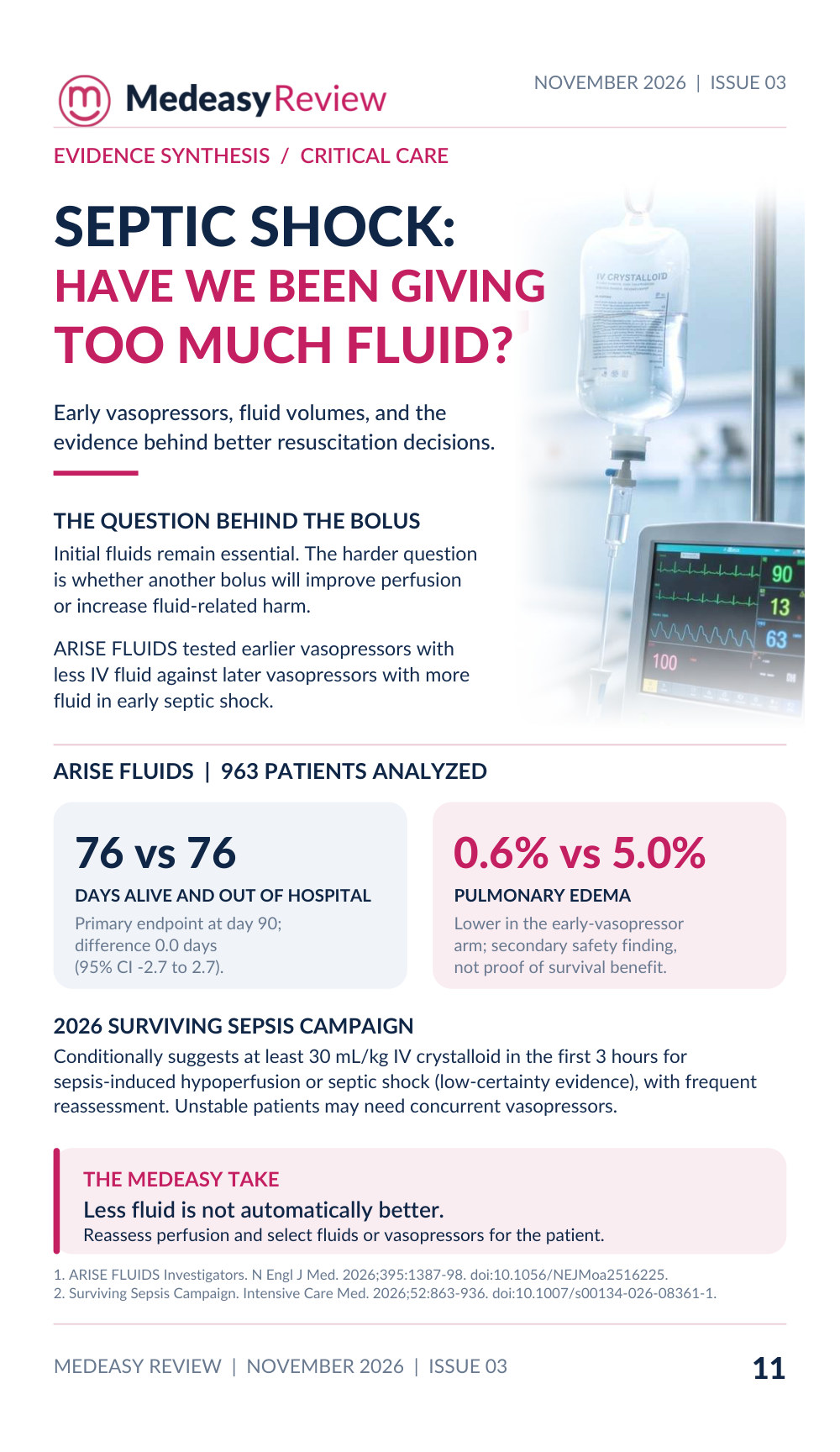
Early vasopressors, fluid volumes, and the evidence behind better resuscitation decisions.
THE QUESTION BEHIND THE BOLUS
Initial fluids remain essential. The harder question is whether another bolus will improve perfusion or increase fluid-related harm.
ARISE FLUIDS tested earlier vasopressors with less IV fluid against later vasopressors with more fluid in early septic shock.
ARISE FLUIDS | 963 PATIENTS ANALYZED
76 vs 76
DAYS ALIVE AND OUT OF HOSPITAL
Primary endpoint at day 90; difference 0.0 days (95% CI -2.7 to 2.7).
0.6% vs 5.0%
PULMONARY EDEMA
Lower in the early-vasopressor arm; secondary safety finding, not proof of survival benefit.
2026 SURVIVING SEPSIS CAMPAIGN
Conditionally suggests at least 30 mL/kg IV crystalloid in the first 3 hours for sepsis-induced hypoperfusion or septic shock (low-certainty evidence), with frequent reassessment. Unstable patients may need concurrent vasopressors.
THE MEDEASY TAKE
Less fluid is not automatically better. Reassess perfusion and select fluids or vasopressors for the patient.
Three Trials. Three Different Contexts.
Different resuscitation phases, interventions, and endpoints.
Neutral primary results do not establish clinical equivalence.
| Trial and population | Strategy | Primary endpoint and result |
|---|---|---|
| 01 / CLOVERS 2023 | EARLY ED HYPOTENSION | n=1,563 | After 1–3 L initial IV fluid; restrictive vs liberal strategy. | 14.0% vs 14.9% Death before discharge home by day 90 Difference −0.9 pp (95% CI −4.4 to 2.6); P=0.61. |
| 02 / CLASSIC 2022 | ICU SEPTIC SHOCK | n=1,554 | After initial IV fluids; restrictive vs standard ICU strategy. | 42.3% vs 42.1% All-cause mortality by day 90 Adjusted difference +0.1 pp (95% CI −4.7 to 4.9); P=0.96. |
| 03 / ARISE FLUIDS 2026 | EARLY ED SEPTIC SHOCK | n=963 ITT | Earlier vasopressors with less fluid vs later with more fluid. | 76 vs 76 days Days alive and out of hospital through day 90 Median difference 0.0 days (95% CI −2.7 to 2.7); P=1.00. |
THE MEDEASY TAKE
Three neutral results do not prove equivalence. Timing, populations, and endpoint choice shape what we can conclude.
Why Three Neutral Results Don’t End the Debate
Different starting lines, fluid exposure windows, and endpoints.
| Trial | Setting | Starting point |
|---|---|---|
| ARISE FLUIDS | ED · early shock | Early ED septic shock; less fluid and earlier vasopressors during a 6-24 h protocol. |
| CLOVERS | ED · after fluids | Hypotension despite 1-3 L IV fluid; randomized within 4 h of meeting criteria. |
| CLASSIC | ICU · after fluids | ICU septic shock after at least 1 L of IV fluid. |
Fluid exposure was not identical
Between-group differences shown below come from different observation periods.
| Trial and fluid difference | Observation period |
|---|---|
| ARISE FLUIDS 1,108 mL less | First 24 h; median difference. |
| CLOVERS 2,134 mL less | 24-h protocol; difference in medians. |
| CLASSIC 1,798 vs 3,811 mL | Cumulative ICU IV fluid through day 90. |
| Trial | Endpoint |
|---|---|
| ARISE FLUIDS | Days alive and out of hospital by day 90 |
| CLOVERS | Death before discharge home by day 90 |
| CLASSIC | All-cause death by day 90 |
04 / WHY CAUTION IS NEEDED
Strategy, not a single dose Fluid and vasopressors were bundled.
Open-label decisions Unblinded and flexible protocols.
No equivalence test Does not establish equivalence.
Context matters Patient fluid needs differ.
THE MEDEASY TAKE
Neutral is not equivalent. No single fluid strategy is proven best for every patient.
The Next Liter? Or the Next Vasopressor?
Five bedside decisions to balance perfusion and fluid-related harm.
BEGIN RESUSCITATION PROMPTLY
The SSC conditionally suggests at least 30 mL/kg IV crystalloid within 3 h for sepsis-induced hypoperfusion or shock. Individualize and reassess. CLINICAL PEARL Reassess during fluid administration.
ASK WHETHER MORE FLUID WILL HELP
Assess perfusion and fluid responsiveness. Use passive leg raising with stroke-volume assessment or other dynamic measures when feasible. CLINICAL PEARL Hypotension alone does not prove fluid responsiveness.
DO NOT DELAY NEEDED VASOPRESSORS
If hypotension persists after initial fluids, use norepinephrine. In unstable shock, concurrent fluids and vasopressors may be warranted. Initial MAP target: about 65 mmHg. CLINICAL PEARL Peripheral initiation requires monitoring and trained care.
REASSESS PERFUSION, NOT JUST MAP
Review mentation, capillary refill, urine output, MAP and lactate trends. An adequate pressure does not necessarily mean adequate tissue perfusion. CLINICAL PEARL Do not give repeated fluids solely to normalize lactate.
WATCH FOR FLUID-RELATED HARM
Before more boluses, review oxygen needs, respiratory status, congestion and fluid balance. Weigh likely benefit against overload risk. CLINICAL PEARL Avoid both under-resuscitation and fluid accumulation.
THE PHILIPPINE
PRACTICE CHECK
Where advanced monitoring is limited, repeat bedside assessment. Vasopressors require trained staff, monitoring and escalation. Give prompt antimicrobials and pursue source control.
THE MEDEASY TAKE
Restore perfusion, not a preset fluid volume. Neither restrictive fluids nor extra boluses are universally superior. Reassess repeatedly, then individualize the balance of fluids and vasopressors.
Read the original magazine · pages 11–14
References
- ARISE FLUIDS Investigators. N Engl J Med. 2026;395:1387–1398. doi:10.1056/NEJMoa2516225.
- CLOVERS Investigators. N Engl J Med. 2023;388:499–510. doi:10.1056/NEJMoa2212663.
- Meyhoff TS, et al. N Engl J Med. 2022;386:2459–2470. doi:10.1056/NEJMoa2202707.
- Prescott HC, et al. Surviving Sepsis Campaign 2026. Intensive Care Med. 2026;52:863–936. doi:10.1007/s00134-026-08361-1.
Editorial content from Medeasy Review Issue 03. Verify recommendations against current guidelines, local approvals, product information, and the individual patient's circumstances.