Surveillance should improve precision, not widen coverage by default. Culture when indicated; reassess empiric therapy and narrow or stop treatment as evidence allows.
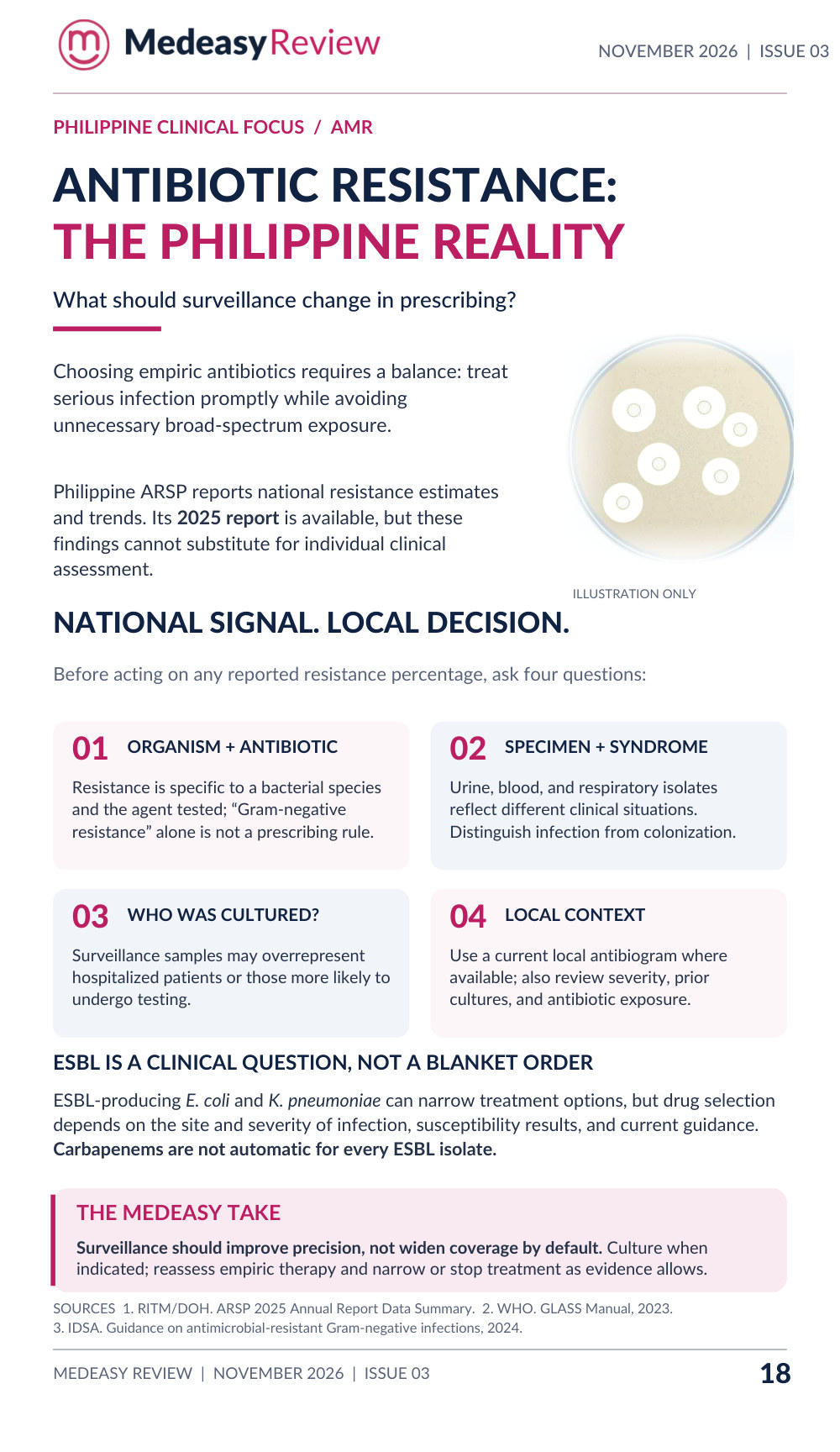
Antibiotic Resistance: The Philippine Reality
What should surveillance change in prescribing?
ILLUSTRATION ONLY
Choosing empiric antibiotics requires a balance: treat serious infection promptly while avoiding unnecessary broad-spectrum exposure.
Philippine ARSP reports national resistance estimates and trends. Its 2025 report is available, but these findings cannot substitute for individual clinical assessment.
NATIONAL SIGNAL. LOCAL DECISION.
Before acting on any reported resistance percentage, ask four questions:
ORGANISM + ANTIBIOTIC
Resistance is specific to a bacterial species and the agent tested; “Gram-negative resistance” alone is not a prescribing rule.
SPECIMEN + SYNDROME
Urine, blood, and respiratory isolates reflect different clinical situations. Distinguish infection from colonization.
WHO WAS CULTURED?
Surveillance samples may overrepresent hospitalized patients or those more likely to undergo testing.
LOCAL CONTEXT
Use a current local antibiogram where available; also review severity, prior cultures, and antibiotic exposure.
ESBL IS A CLINICAL QUESTION, NOT A BLANKET ORDER
ESBL-producing E. coli and K. pneumoniae can narrow treatment options, but drug selection depends on the site and severity of infection, susceptibility results, and current guidance. Carbapenems are not automatic for every ESBL isolate.
THE MEDEASY TAKE
Surveillance should improve precision, not widen coverage by default. Culture when indicated; reassess empiric therapy and narrow or stop treatment as evidence allows.
The Numbers Behind Philippine AMR
Six resistance signals from Philippine sentinel surveillance.
ARSP 2025 155,138 infections analyzed 28 sentinel sites Percentages below = resistant isolates / isolates tested for that specific antibiotic.
| Organism and reported infections | Antibiotic | Resistance |
|---|---|---|
| Escherichia coli (all reported infections n=17,248) | Ciprofloxacin | 45.90% |
| Escherichia coli (all reported infections n=17,248) | Ceftriaxone | 38.99% |
| Klebsiella pneumoniae (all reported infections n=20,732) | Meropenem | 17.41% |
| Klebsiella pneumoniae (all reported infections n=20,732) | Piperacillin/tazobactam | 35.40% |
| Acinetobacter baumannii (all reported infections n=8,207) | Meropenem | 44.23% |
| Streptococcus pneumoniae (all reported infections n=439) | Penicillin — NON-MENINGITIS breakpoint | 1.55% |
Substantial carbapenem resistance in tested isolates; interpret within the infection setting.
Do not apply this percentage to suspected pneumococcal meningitis.
HOW TO READ THE NUMBERS
Organism totals are not antibiotic-specific testing denominators. Sentinel sampling, selective cultures, and laboratory access may bias estimates.
THE MEDEASY TAKE
High resistance deserves attention; low resistance matters too. Use local antibiograms and individual cultures when available, not national figures alone.
From Resistance Data to Better Prescribing
Five decisions that make antibiotic treatment more precise.
ARSP 2025 informs risk; local data and the patient guide treatment.
ESTABLISH THE CLINICAL INDICATION
Assess whether bacterial infection requires treatment. Distinguish infection from colonization, contamination, and noninfectious illness.
Asymptomatic bacteriuria: usually no treatment; key exceptions include pregnancy and certain urologic procedures.
OBTAIN APPROPRIATE MICROBIOLOGY
Collect syndrome-appropriate cultures before antibiotics when feasible, without materially delaying care for sepsis or other serious infection.
Well-collected specimens can enable targeted therapy and avoid unnecessary broad coverage.
SELECT EMPIRIC THERAPY INTELLIGENTLY
Consider source, severity, prior cultures, recent antibiotics, resistance risks, and the current facility antibiogram.
National ARSP estimates complement, but do not replace, a local antibiogram.
REASSESS AND REFINE
Review the diagnosis, cultures, susceptibility, and clinical response. Continue, narrow, change, or stop therapy when appropriate.
A 48–72-hour review is useful; reassess sooner whenever new findings warrant.
OPTIMIZE DURATION AND ROUTE
Use syndrome-appropriate dosing and duration. Consider oral step-down when stable, with source control and an active oral option.
Antibiotic resistance alone does not mandate a longer course.
THE PHILIPPINE
PRACTICE CHECK
Use facility guidance and local antibiograms where available. Prioritize cultures in serious infections and seek expert input for complex resistance.
THE MEDEASY TAKE
The best antibiotic is not always the broadest. Treat promptly when indicated, then refine using response and microbiology.
Read the original magazine · pages 18–20
References
- 1. RITM/DOH. ARSP 2025 Annual Report Data Summary. 2. WHO. GLASS Manual, 2023. 3. IDSA. Guidance on antimicrobial-resistant Gram-negative infections, 2024.
- DOH-RITM. ARSP 2025 Annual Report (published July 2026). Figures 89 (p64), 108 (p79), 143 (p108), and 8 (p15).
- DOH-RITM ARSP 2025 (2026); DOH AO 2023-0011; CDC Stewardship (2019); IDSA ASB (2019).
Editorial content from Medeasy Review Issue 03. Verify recommendations against current guidelines, local approvals, product information, and the individual patient's circumstances.