Evidence informs the choice. Patient risk, clinical judgment and access guide the next step.
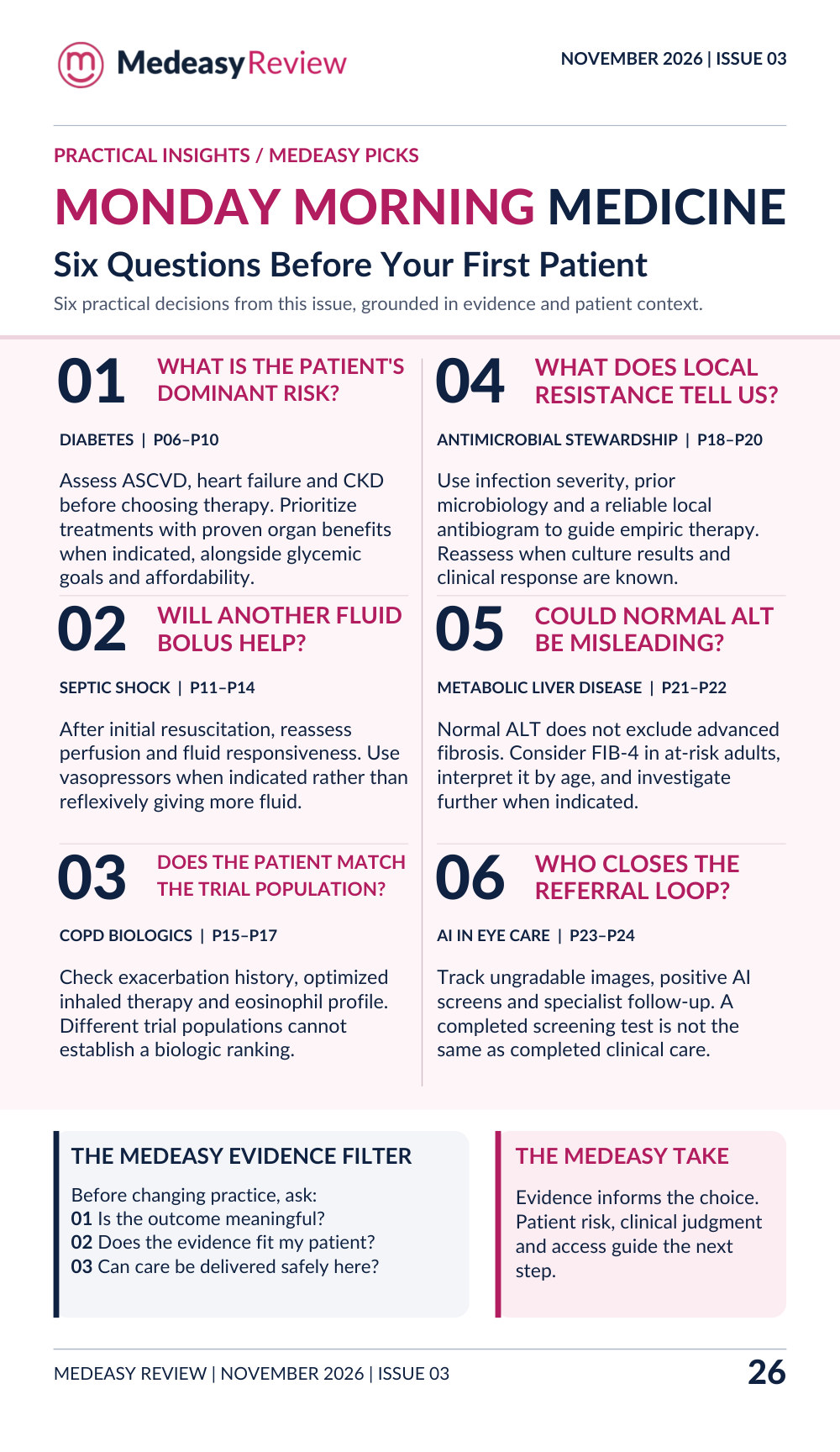
Monday Morning Medicine
Six Questions Before Your First Patient
Six practical decisions from this issue, grounded in evidence and patient context.
WHAT IS THE PATIENT'S
DOMINANT RISK?
DIABETES | P06–P10
Assess ASCVD, heart failure and CKD before choosing therapy. Prioritize treatments with proven organ benefits when indicated, alongside glycemic goals and affordability.
WILL ANOTHER FLUID
BOLUS HELP?
SEPTIC SHOCK | P11–P14
After initial resuscitation, reassess perfusion and fluid responsiveness. Use vasopressors when indicated rather than reflexively giving more fluid.
DOES THE PATIENT MATCH
THE TRIAL POPULATION?
COPD BIOLOGICS | P15–P17
Check exacerbation history, optimized inhaled therapy and eosinophil profile. Different trial populations cannot establish a biologic ranking.
WHAT DOES LOCAL
RESISTANCE TELL US?
ANTIMICROBIAL STEWARDSHIP | P18–P20
Use infection severity, prior microbiology and a reliable local antibiogram to guide empiric therapy. Reassess when culture results and clinical response are known.
COULD NORMAL ALT
BE MISLEADING?
METABOLIC LIVER DISEASE | P21–P22
Normal ALT does not exclude advanced fibrosis. Consider FIB-4 in at-risk adults, interpret it by age, and investigate further when indicated.
WHO CLOSES THE
REFERRAL LOOP?
AI IN EYE CARE | P23–P24
Track ungradable images, positive AI screens and specialist follow-up. A completed screening test is not the same as completed clinical care.
THE MEDEASY EVIDENCE FILTER
Before changing practice, ask: 01 Is the outcome meaningful? 02 Does the evidence fit my patient? 03 Can care be delivered safely here?
THE MEDEASY TAKE
Evidence informs the choice. Patient risk, clinical judgment and access guide the next step.